
Drain Cleaning in Palm Bay FL
Drain cleaning handles the gradual side of drainage problems: sinks that empty slowly, tubs that pool, showers that drain after you do, and lines that gurgle their way through a wash cycle.
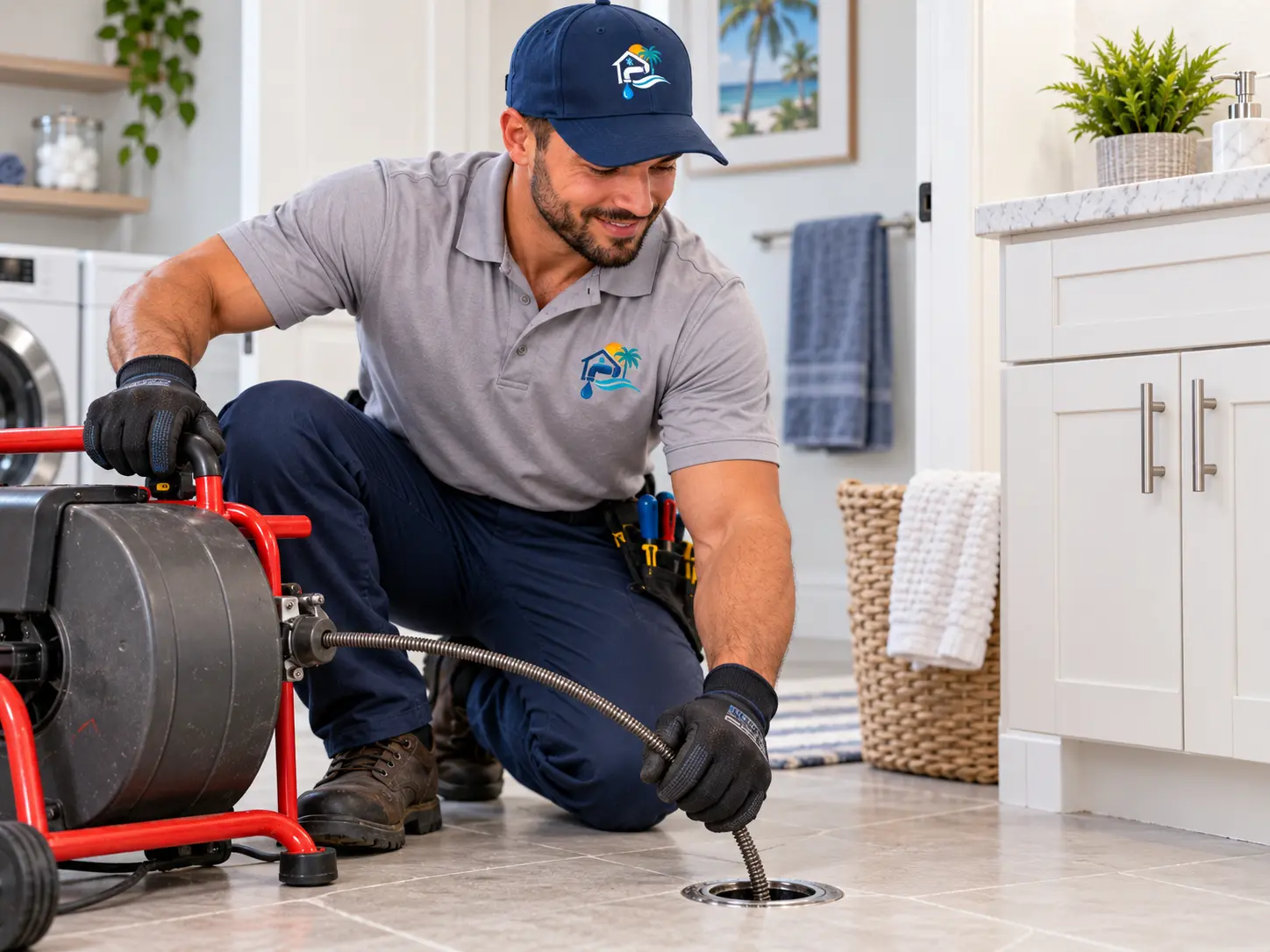
A drain rarely fails all at once. It narrows. Soap film, hair, cooking fats and food particles bond to the pipe wall, the effective diameter shrinks, and the water starts taking longer to go down until one day it does not go down at all.
Cleaning a drain at the slow stage is straightforward maintenance. Waiting until it stops completely turns it into a blockage removal job, and repeated blockages in the same line often point at something structural rather than a buildup problem.
Drain cleaning, clogged drain repair and sewer work are not the same job
These three overlap enough to confuse people, so it is worth being precise. Drain cleaning is preventative and restorative work on a line that still flows, or has just stopped flowing, because of accumulation.
Clogged drain repair addresses a specific, severe obstruction in one fixture — a toy in a toilet trap, a grease plug in a kitchen branch, a hair mass at a shower drum trap. The goal is removing one identified thing.
Sewer line repair deals with the main line that carries everything out of the house. When several fixtures back up together, or when the same line clogs every few months, the issue is usually the main rather than the branch, and clearing it repeatedly is treating a symptom.
What causes drains to slow down
- Kitchen lines: cooking grease cooling and hardening onto pipe walls, plus food solids
- Bathroom sinks: toothpaste, hair and soap scum collecting at the trap and stopper assembly
- Showers and tubs: hair bound with soap film, often at the strainer or drum trap
- Laundry: lint and detergent residue, especially in older lines with rough interiors
- Floor drains: sediment, dust and dried traps that lose their water seal
- Any line: pipe scale, sagging sections that hold water, and roots at joints outside
How drains are actually cleared
Mechanical clearing with a cable machine is the standard approach for branch lines. The cable is fed through the cleanout or the fixture opening, cuts through the obstruction, and scrapes buildup from the pipe wall on the way back out. It works on hair, grease and solids alike.
Hydro jetting uses high-pressure water to scour the interior of the line rather than bore a hole through the blockage. It is the better choice for heavy grease accumulation and for restoring a line closer to its original diameter, though it is not appropriate for every pipe condition.
Camera inspection is used when a line clogs repeatedly. Rather than guessing, the camera shows whether the pipe has a belly holding water, a broken section, an offset joint, or root intrusion. That distinction determines whether you keep cleaning or start planning a repair.
Why chemical drain cleaners cause more problems than they solve
Store-bought caustic cleaners work by generating heat and dissolving organic matter near the top of the blockage. On a fully stopped line, most of the product sits in standing water above the clog and never reaches it.
The heat and chemistry are hard on older pipe, on rubber gaskets and on chrome trap arms. They also make the next step worse: a line full of caustic liquid is a hazard for anyone who then has to open the trap. Enzyme-based maintenance products are a gentler option for slow drains, though they work slowly and will not clear an established blockage.
Keeping drains clear between visits
- Pour cooking grease into a container and throw it away rather than rinsing it down
- Use a strainer in every shower and tub, and clean it weekly
- Run cold water while a garbage disposal grinds, and keep fibrous scraps out of it
- Flush seldom-used drains occasionally so traps do not dry out and release odor
- Treat the second slow-down in the same line as a signal, not a coincidence
What this work usually costs
Cost tracks access and severity more than fixture type. A line with an accessible cleanout that clears with a cable in one pass is the low end. Pulling a toilet to reach a line, jetting heavy grease, or adding a camera inspection raises it. Repeated visits to the same line usually indicate the money belongs in a diagnosis instead.
The plumbing cost guide breaks down the variables in detail, and the cost calculator turns them into a planning range you can budget against.
Related plumbing services
Where this service is available
Palm Bay is the primary service market, along with these nearby Brevard County communities:
Drain Cleaning questions
What causes drains to keep clogging?
Recurring clogs in the same line almost always mean the line itself has a problem rather than the household habits around it. Common causes are a sagging section that holds standing water and collects solids, a partially collapsed or offset joint, roots entering through a crack outside, or a pipe interior so scaled that the effective diameter is a fraction of the original. Clearing it makes the fixture usable again but does not change the underlying geometry, which is why a camera inspection is worth doing after the second or third repeat.
Is hydro jetting better than cabling?
They solve different problems. Cabling is fast, effective on hair and solid obstructions, and appropriate for most branch lines. Jetting cleans the full circumference of the pipe and is the better tool for hardened grease in kitchen and commercial lines, or when the goal is restoring the line rather than punching through a blockage. Jetting is not right for every pipe — older, brittle or already-damaged lines can be made worse by high pressure, which is one reason a camera inspection often comes first.
How often should drains be cleaned?
There is no universal schedule for a typical home. Most households only need attention when flow noticeably slows. Kitchens in homes that cook frequently, properties with a history of root intrusion, and rentals with heavy turnover benefit from periodic maintenance cleaning before problems appear. The practical rule: if a line has backed up more than once in a year, put it on a maintenance interval or investigate the cause rather than waiting for the next backup.
Can a slow drain be a sign of a bigger problem?
It can. A single slow fixture with everything else draining normally is almost always a local buildup issue. Slowness that shows up across multiple fixtures — especially the lowest ones in the home, or a toilet that gurgles when the tub drains — suggests a restriction in the main line where all the branches combine. Venting problems produce similar symptoms, since a drain that cannot pull air will glug and drain slowly even with a perfectly clear pipe.
Need Plumbing Help in Palm Bay?
Describe what is happening and get help scheduling the right plumbing service for your home.