
Sewer Line Repair in Palm Bay FL
When several drains back up together, or the same line clogs every few months, the problem has moved past the fixtures. The main line is where everything in the house converges.
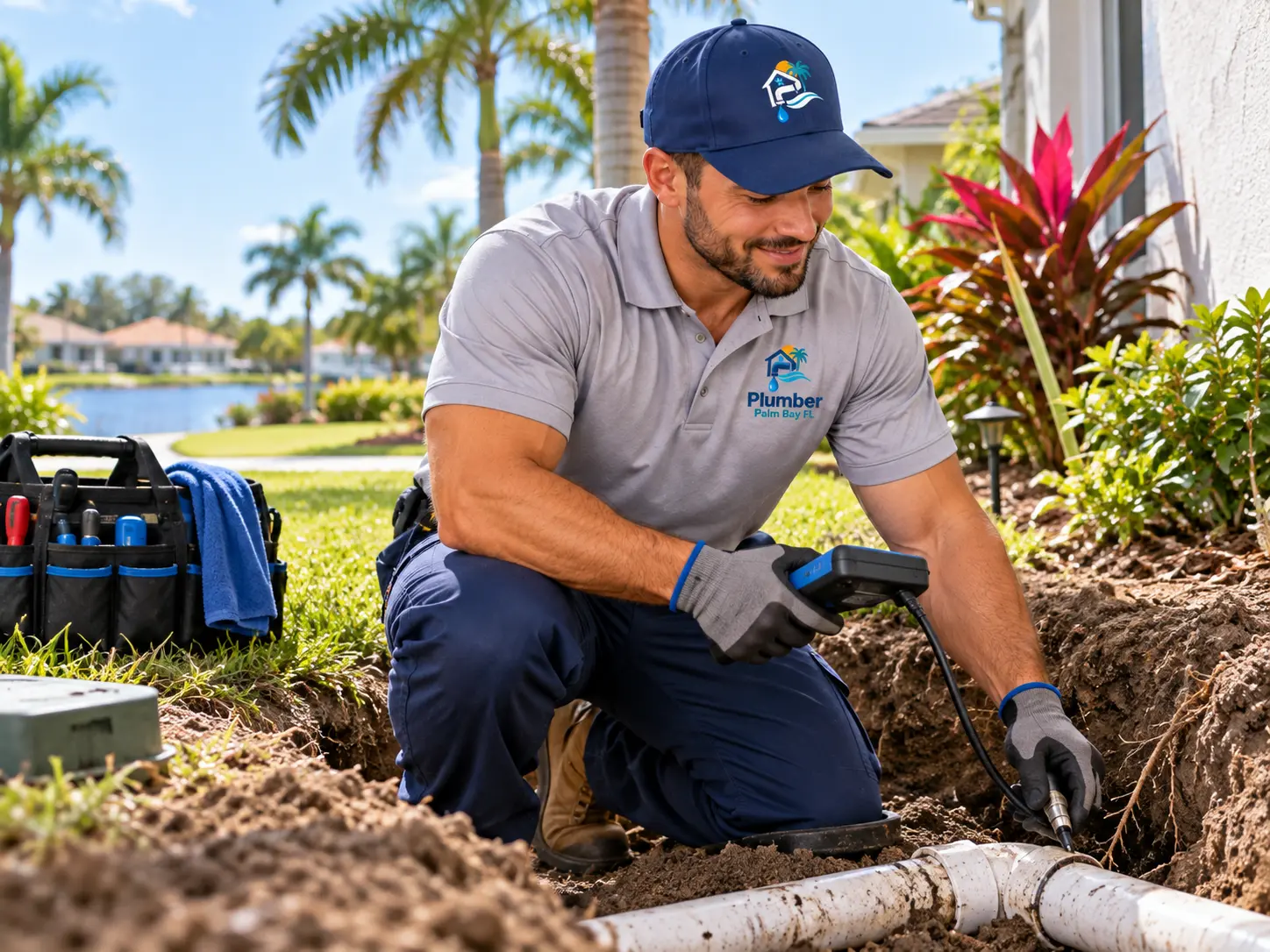
The main sewer line carries every drain in the house to the municipal connection or septic tank. It is buried, it is under no pressure, and it depends on consistent slope to move waste. Any defect along its length affects every fixture upstream.
Because it is invisible, sewer problems are diagnosed by pattern. Multiple fixtures involved, backups at the lowest drains, and repeat events at regular intervals all point to the main rather than a branch.
Symptoms of a main line problem
- Several fixtures draining slowly or backing up around the same time
- Water appearing in a tub or shower when a toilet is flushed
- Gurgling from a toilet or floor drain while the washing machine drains
- Sewage odor indoors or near the cleanout outside
- Repeated backups in the same line every few months
- Unusually lush or soggy ground along the path of the sewer line
What causes sewer lines to fail
Root intrusion is the most common cause in established neighborhoods with mature landscaping. Roots follow moisture and enter through joints and small cracks, then expand until they catch solids and restrict flow. Clearing them restores service; the entry point remains until it is repaired.
Ground movement produces bellies — sagging sections that hold standing water and collect solids — and offset joints where two sections no longer line up. Older cast iron corrodes internally, losing diameter and eventually its structural integrity. Damage from excavation, heavy equipment or nearby construction accounts for a share as well.
Non-flushable items contribute in a different way. Wipes, hygiene products and grease do not cause the defect, but they find any imperfection in the line and turn an intermittent restriction into a full blockage.
Diagnosis before repair
Camera inspection is the step that turns guesswork into a plan. The camera travels the line from the cleanout, shows the condition of the pipe, and identifies the exact nature and location of the defect — roots, belly, offset, crack or collapse.
Locating equipment marks the position and depth of the defect at the surface, which is what makes a targeted repair possible instead of exploratory digging. Without that step, any repair proposal is an estimate built on assumptions, and it is reasonable to ask to see the footage before approving significant work.
Repair options
Cleaning and root cutting restores flow when the line is structurally sound. It is the right immediate response to a backup and, on a maintenance interval, a legitimate long-term strategy for a line with minor root intrusion that is otherwise intact.
Spot repair excavates and replaces a defined damaged section, appropriate when the rest of the line is in good condition. Trenchless methods — pipe lining and pipe bursting — rehabilitate or replace a line with minimal excavation, and they preserve driveways, walkways and landscaping. They require the existing line to meet certain conditions, which the camera inspection determines.
Full replacement applies where the line has collapsed, has severe bellies, or has degraded along its entire length. It is the largest version of this work and the one where a documented diagnosis matters most.
Septic systems
Some properties in and around Palm Bay are on septic rather than municipal sewer. Symptoms overlap: slow drains, backups and odor. The causes differ, since a full tank, a saturated drain field or a failed pump produces the same indoor signs as a blocked lateral.
Knowing which system serves the property changes the diagnostic path, so it is one of the first questions worth answering. If you are unsure, county records or the presence of a tank lid and drain field area in the yard will usually settle it.
What this work usually costs
Sewer work has the widest cost range of any residential plumbing service. Clearing a main line with an accessible cleanout is comparatively modest. Camera inspection adds a defined amount. Spot excavation, trenchless lining and full replacement scale with depth, length, soil conditions and what has to be removed and restored above the pipe.
The plumbing cost guide breaks down the variables in detail, and the cost calculator turns them into a planning range you can budget against.
Related plumbing services
Where this service is available
Palm Bay is the primary service market, along with these nearby Brevard County communities:
Sewer Line Repair questions
Can multiple slow drains indicate a sewer problem?
Yes, and it is the clearest single indicator there is. Individual fixture clogs are local — one sink, one tub, one toilet. When several fixtures slow down or back up during the same period, the restriction is downstream of where those drains combine, which means the main line. The pattern is often most obvious at the lowest fixtures in the home, since gravity puts the overflow there first. A toilet that gurgles when the washing machine drains is the same signal: air being displaced through a partially restricted main.
How do roots get into a sewer pipe?
Roots grow toward moisture and nutrients, both of which a sewer line supplies. They cannot penetrate sound pipe wall, but they exploit anything imperfect: a joint that has separated slightly, a hairline crack, a deteriorated seal on older clay or cast iron. Once a fine root reaches the interior it thickens over time, forming a mesh that catches paper and solids. Cutting the roots restores flow and is a legitimate maintenance approach, but the entry point stays open, so growth resumes. Lining or replacing the affected section is what stops the cycle.
Is trenchless sewer repair always an option?
No, and that is why the camera inspection comes first. Lining requires an existing pipe with enough structural integrity to serve as a host, and pipe bursting requires a workable path and suitable surrounding conditions. Severe bellies are generally not corrected by lining, since the sag is a slope problem rather than a pipe-wall problem. Collapsed sections may block the equipment entirely. Where conditions do suit it, trenchless work is often the better value once the cost of restoring driveways, walkways and landscaping is included in the comparison.
Who is responsible for the sewer lateral?
In most municipal arrangements the property owner is responsible for the lateral running from the building to the connection at the main, with the utility responsible for the main itself. The precise dividing point varies by jurisdiction, and it is worth confirming with the local utility before authorizing work, particularly when the defect is close to the street. If the problem turns out to be in the public main, that is the utility's repair. A camera inspection that documents the location and depth of the defect is what supports that conversation.
Need Plumbing Help in Palm Bay?
Describe what is happening and get help scheduling the right plumbing service for your home.