
Water Heater Repair in Palm Bay FL
Most hot water complaints trace back to a handful of components. This page covers what each symptom usually means and where the line falls between repairing a heater and replacing it.
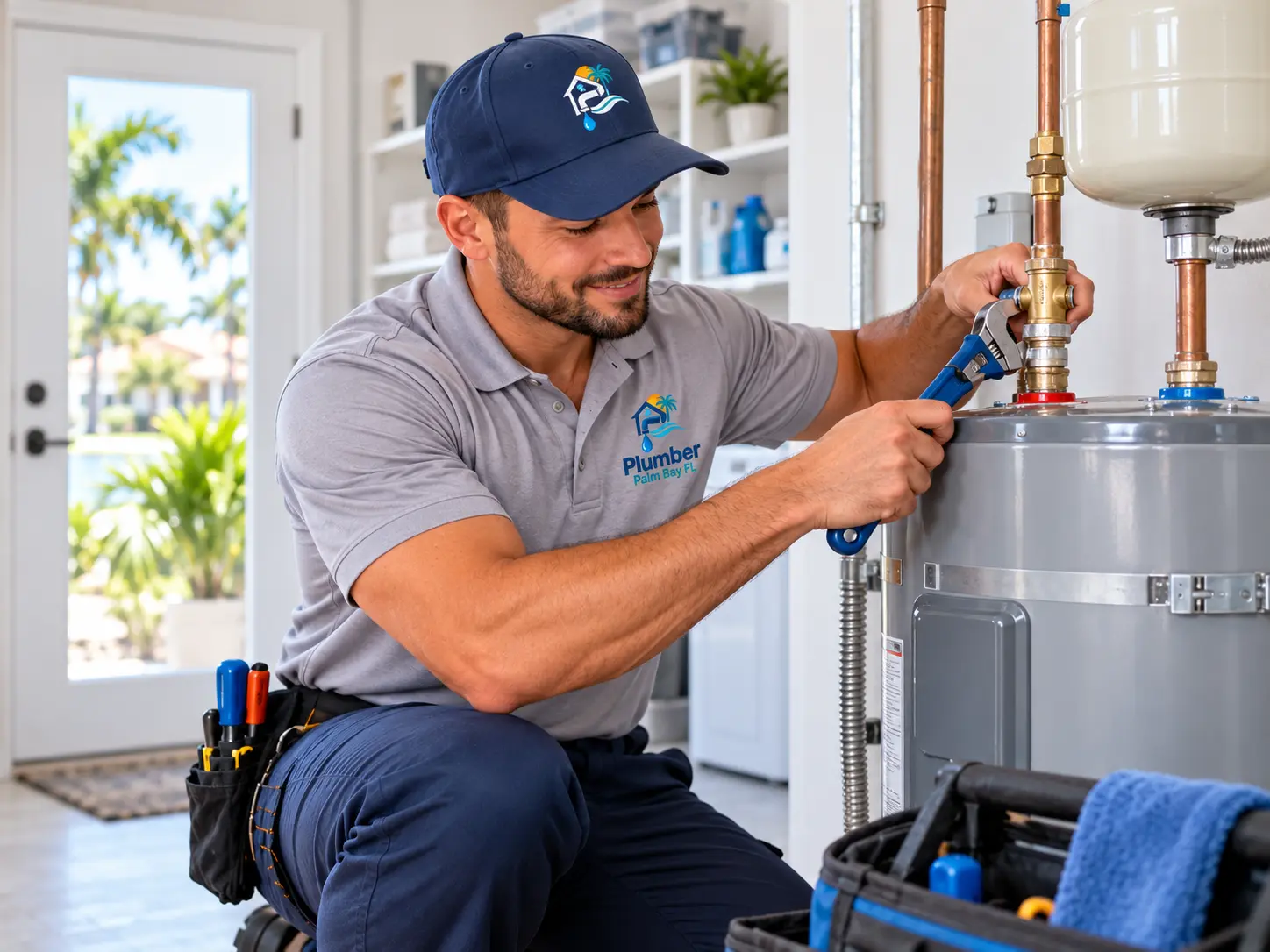
A water heater is a simple machine with a short list of failure points: heating elements or burners, thermostats, the dip tube, the anode rod, the relief valve, and the tank itself. Diagnosis is mostly a matter of matching the symptom to the component.
The one failure that is not repairable is the tank. Steel tanks corrode from the inside, protected by a sacrificial anode rod that eventually depletes. Once the tank wall is breached, no repair restores it — which is why the location of a leak matters more than its size.
What each symptom usually means
- No hot water at all: failed upper element or thermostat on electric units; pilot, thermocouple or gas valve on gas units; tripped breaker or high-limit switch on either
- Hot water runs out quickly: failed lower element, broken dip tube, undersized tank for current demand, or heavy sediment reducing usable volume
- Lukewarm water: thermostat set low, one of two elements out, or crossover through a mixing valve
- Popping or rumbling: sediment layer on the tank bottom trapping water that flashes to steam as it heats
- Rusty or discolored hot water: depleted anode rod and internal corrosion, or corroded galvanized piping upstream
- Water around the base: could be a fitting, the relief valve discharge, or the tank body — the difference decides everything
Sediment and Brevard County water
Mineral content in the local supply settles as sediment inside the tank, forming an insulating layer between the burner or lower element and the water above it. That layer forces longer heating cycles, raises energy use, and produces the popping sound many homeowners hear before anything else fails.
Periodic flushing removes loose sediment and extends usable life. It is also the maintenance task most often skipped, which is why heaters here frequently underperform their rated lifespan. Checking the anode rod at the same interval is the other high-value habit, since a depleted rod means the tank has started spending its own steel.
What a repair visit typically involves
Testing comes before parts. On electric units that means checking incoming voltage, the high-limit reset, both thermostats and both elements for continuity. On gas units it means verifying the pilot or igniter, thermocouple, gas supply and venting.
Once the failed component is identified, most repairs are self-contained: a replacement element and gasket, a thermostat, a thermocouple, a gas control valve, a dip tube, or a relief valve. The heater is refilled, purged of air, and observed through a full heating cycle to confirm the fix.
Any repair should include a look at the whole unit — connections, venting, relief discharge routing and the drain pan. A heater that needs a part today may also be showing signs of what it will need next.
Repair or replace
Repair makes sense when the tank is sound, the unit is within a reasonable portion of its expected service life, and the failed part is a serviceable component. Elements, thermostats and thermocouples are routine, inexpensive repairs on a heater that is otherwise healthy.
Replacement becomes the better economic choice when the tank itself leaks, when the unit is well past its typical lifespan and needs a significant part, when repeated repairs are stacking up, or when capacity no longer matches the household. If you are at that point, water heater installation covers tank and tankless options and what each involves.
Safe checks before you call
- Confirm the breaker has not tripped, and press the red high-limit reset once if the unit is electric
- Verify the thermostat setting has not been changed; 120°F is the common reference point
- Look for water in the drain pan and note whether it is under the tank or at a fitting
- Listen for popping during a heating cycle and note it for the diagnosis
- Do not attempt to open an electric heater's access panels — the elements carry line voltage
What this work usually costs
Component repairs occupy a wide band. A thermostat or element replacement on an accessible unit is at the low end; a gas control valve, a heater in a tight closet or attic, or a diagnosis that requires draining the tank pushes higher. When a repair estimate approaches half the cost of replacement on an aging unit, the arithmetic usually favors replacement.
The plumbing cost guide breaks down the variables in detail, and the cost calculator turns them into a planning range you can budget against.
Related plumbing services
Water Heater Installation
Tank and tankless replacement and new installation.
See water heater installationWhere this service is available
Palm Bay is the primary service market, along with these nearby Brevard County communities:
Water Heater Repair questions
Should I repair or replace my water heater?
Look at three things: where the leak is, how old the unit is, and what the repair costs relative to replacement. A leak from the tank body ends the discussion — that unit is finished, because the steel has corroded through. If the tank is dry and the failure is an element, thermostat, thermocouple or valve, repair is usually sensible and inexpensive. The gray zone is an older unit needing a substantial part. As a general rule, once repair costs reach roughly half of replacement on a heater near the end of its expected life, replacement is the better use of the money.
Why does my water heater make popping noises?
That sound is sediment. Minerals settle out of the water and form a hardened layer on the bottom of the tank, and water trapped under that layer superheats and flashes to steam, forcing its way up through the deposit with an audible pop or rumble. It is not immediately dangerous, but it signals reduced efficiency, longer recovery times and extra stress on the tank bottom. Flushing can remove loose sediment. Once the layer has hardened, flushing helps less, and the noise becomes a reminder of accumulated wear.
How long should a water heater last here?
Manufacturers commonly cite eight to twelve years for a conventional tank unit, and tankless units are typically rated longer. Local water quality and maintenance move that number in both directions. A tank flushed periodically with an anode rod replaced when depleted will generally reach the upper end of its range. One that has never been serviced often falls short of it. Age alone is not a reason to replace a working heater, but past the ten-year mark it is reasonable to plan for replacement rather than be surprised by it.
Is water in the drain pan always a leak from the tank?
No, and the difference is worth checking before assuming the worst. Water in the pan can come from condensation on a cold inlet in a humid space, from a loose fitting or union at the top of the unit, from the temperature and pressure relief valve discharging, or from the drain valve weeping. Dry the pan, then look at where new water reappears. Water forming at the base of the tank body itself, with dry connections above, is the one that means the tank has failed.
Need Plumbing Help in Palm Bay?
Describe what is happening and get help scheduling the right plumbing service for your home.